
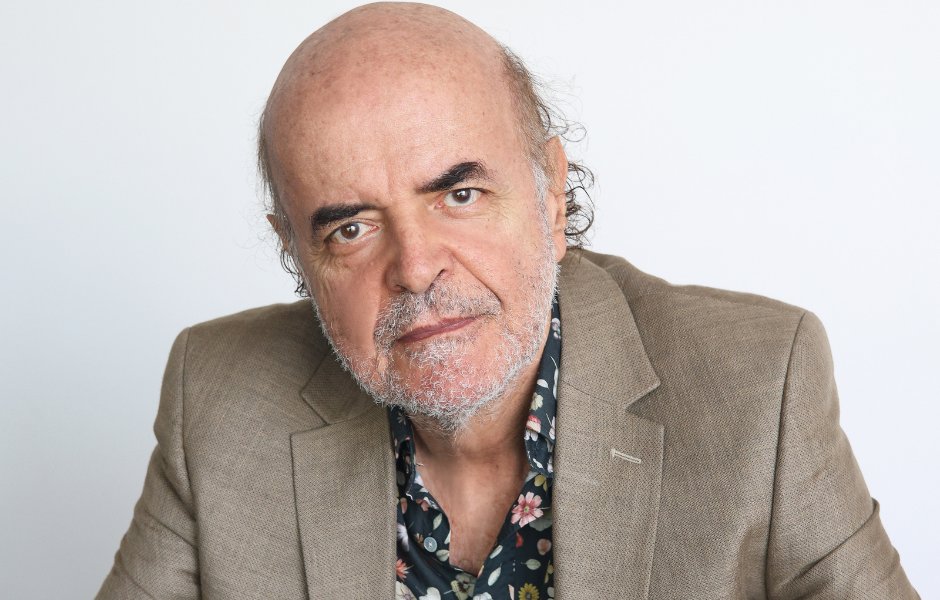
Bodossaki Excellence Award 2026 | Technological Sciences
He was born in Athens in 1949, but he grew up in Lidoriki, in central Greece, where his father, Harilaos, served as a mathematics teacher. His mother, Viktoria, was also an educator, and from her he inherited a love of history and literature. He graduated from Varvakeio high school in Athens in 1967 and went on to study at the National Technical University of Athens at the School of Electrical and Mechanical Engineering. The engineering studies did not inspire him, except for a few glimpses into information theory and control theory. He served in the Greek Army during the years of the military junta, an experience that helped him decide to leave Greece.
He was admitted to Princeton in 1973 for PhD, and his three years there were the most formative of his life. He discovered that the scientific discipline he had long been dreaming of not only existed but was in the very process of defining itself: the theoretical understanding of computation — its power and its fundamental limitations. His PhD thesis and early work centered on efficient algorithms and on computational complexity theory: the profound realization that certain problems may admit no efficient solution whatsoever.
Ιn 1976, he joined Harvard as an Assistant Professor and then moved to MIT as an Associate Professor. In 1981 he was appointed Professor at his alma mater in Athens, where he taught computer science for eight years, while simultaneously holding a professorship at Stanford. In 1996 he moved to UC Berkeley, where he taught for 22 years. Berkeley transformed him as a scientist. It inspired him to venture far beyond his home discipline — to use computer science as a lens through which to understand biology and evolution, economics and game theory, and, more recently, neuroscience and the nature of language. Berkeley also inspired him to write my first novel, and he has not stopped writing since.
In 2017 he moved to New York and Columbia University, where he is currently teaching, and in 2022 he co-founded “Archimedes”, an AI research institute in Athens.
He is one of the founders of algorithmic game theory, which introduced rigorous computational thinking into economics and strategic behaviour—contributions that proved instrumental to our understanding of the Internet. His current research is about the computational understanding of brain and language, as well as exploring the limits of AI, since he believes that the most inspiring and important questions are still ahead of us.
He is a Member of the Academy of Athens since 2024 and of the United States National Academy of Sciences, the National Academy of Engineering, and the American Academy of Arts and Sciences.
He has been honored with numerous scientific awards: ACM Fellow (2002), Knuth Prize (2002), IEEE Charles Babbage Award (2004), Katayanagi Prize (2008), Game Theory Society’s Game Theory and Computer Science Prize (2008), ACM-EATCS 2012 Gödel prize, EATCS award (2015), IEEE von Neumann Medal (2016), ETH platinum-gold price for education in CS (2016), Winner of the Harvey Prize, Technion, 2019. IEEE Women Pioneers of the ENIAC award (2022), John von Neumann Theory Prize (2023). In 2014, the President of the Hellenic Republic appointed him Commander of the Order of the Phoenix. He has also received ten honorary doctoral degrees.
Ηis enduring passion is teaching. Over the years he has taught a wide range of courses and seminars spanning nearly every facet of Computer Science, as well as subjects in biology, mathematics, operations research, neuroscience, and the history of science. He regards his writing as a natural extension of his teaching and he has written three novels; his fourth work — Genesis, a graphic novel, is forthcoming in the autumn.
Christos Papadimitriou is married to Martha Sideri, a former Professor of Computer Science at the Athens University of Economics and Business. All three of their daughters are university professors in North America.