
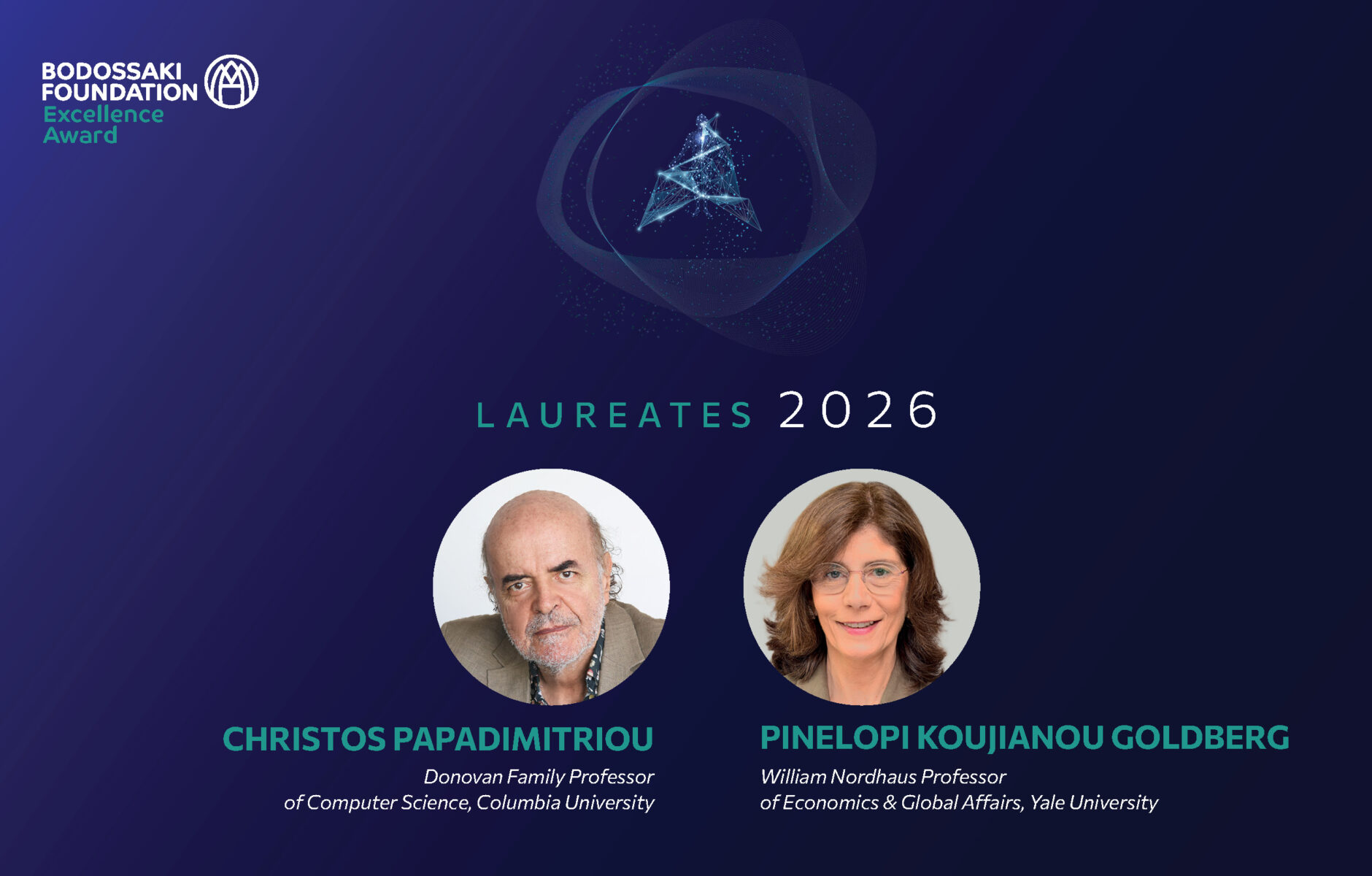
The preeminent theoretical computer scientist, Christos Papadimitriou and the internationally renowned economist, Pinelopi Koujianou Goldberg, are honoured for their decisive contributions to science
The Bodossaki Foundation announces the two distinguished Greek scientists who are being honoured with the Bodossaki Excellence Award 2026 for their pioneering and internationally recognised life’s work, which contributes decisively to the advancement of science.
- In the field of Technological Sciences, the 2026 Bodossaki Excellence Award is presented to Christos Papadimitriou, Donovan Family Professor of Computer Science, Columbia University, USA.
- In the field of Social Sciences, the 2026 Bodossaki Excellence Award is presented to Penelope Koujianou Goldberg, William Nordhaus Professor of Economics and Global Affairs at Yale University, USA.
The Bodossaki Excellence Awards will be presented by the President of the Republic, Mr Konstantinos An. Tasoulas, at the Award Ceremony to be held on Thursday 25 June 2026 at Megaron the Athens Concert Hall.
The Bodossaki Excellence Award is awarded biennially to Greeks who have dedicated their lives to science, and is accompanied by a cash prize of €100,000. The Excellence Award Committee is responsible for evaluating nominations and selecting the laureates. The Committee is composed of eight internationally renowned foreign scientists who hold top scientific distinctions, including the Nobel Prize in Economics, the BBVA Foundation Frontiers of Knowledge Prize, the Boltzmann Medal, the Lorentz Medal, the Spinoza Prize and the NIH Director’s Pioneer Award, as well as being distinguished members of scientific academies.
“The objective of the Bodossaki Excellence Award is twofold: on the one hand, to serve as our country’s most elevated scientific recognition for Greek scientists who, through their dedication to science, their integrity and creative spirit, have expanded the frontiers of knowledge and left their mark on the advancement of science; on the other hand, the Award showcases crucial role models for the generations to come,” notes Athina Dessypri, President of the Board of Trustees of the Bodossaki Foundation. “The institution relies on a rigorous and impartial evaluation process, with the contribution of an Excellence Award Committee composed of foreign scientists of international standing who have themselves made a profound scientific impact. It is with great pleasure that we welcome Ms Pinelopi Koujianou Goldberg and Mr Christos Papadimitriou into the prestigious circle of the institution’s laureates.”
The laureates’ lifelong scientific contributions
Christos Papadimitriou: The limits of computation
Christos Papadimitriou has had a decisive influence on theoretical computer science.
His early research laid the mathematical foundations of computational complexity theory—the rigorous study of what computers can and cannot solve efficiently. His contribution to the theory of approximation algorithms demonstrated not only that intractable optimisation problems can be tackled through algorithms that provably approach the optimal solution, but also when even approximation lies beyond the limits of feasibility. He also pioneered the study of problems—such as finding equilibrium points in games—where mathematical theory guarantees the existence of a solution, yet the solution remains computationally intractable. This body of work provides the language and the tools on which much of modern algorithmic design is based.
Over the last three decades, Christos Papadimitriou has pursued an ambitious research agenda: the use of computational theory as an interpretative tool for understanding other sciences. He is one of the founders of algorithmic game theory, which introduced rigorous computational thinking into economics and strategic behaviour—contributions that proved instrumental to our understanding of the Internet. Since 2005, his interests have expanded into biology and evolutionary theory, and more recently, into the study of the brain and artificial intelligence, where his investigations have focused on the computational and biological foundations of intelligence and language.
Christos Papadimitriou has played a decisive role in popularising modern computational theory among students and the broader public alike, through textbooks but also through novels in which mathematics and computer science serve as the structural backbone of the narrative.
He studied at the National Technical University of Athens and at Princeton, and has taught at Harvard, MIT, Stanford, UCSD, the National Technical University of Athens, and—for 22 years—at UC Berkeley. Since 2017, he has been a professor at Columbia University and co-founder of “Archimedes”, the Greek AI research institute.
Christos Papadimitriou has been a full member of the Academy of Athens since 2024. He is also a member of the United States National Academy of Sciences, the National Academy of Engineering and the American Academy of Arts and Sciences.
Pinelopi Koujianou Goldberg: An empirical analysis of global trade and development
Pinelopi Koujianou Goldberg is a leading researcher in the empirical analysis of global trade policy, with a focus on international trade and development issues. By combining microeconomic data with structural economic models, she has produced critical estimates regarding the impact of globalisation on social well-being and the unequal distribution of its benefits both between and within countries.
She studied economics at the University of Freiburg and went on to complete her graduate studies and Ph.D. at Stanford. She has held tenured professorships at Princeton and Columbia, as well as at Yale, where she currently serves as the William Nordhaus Professor of Economics and Global Affairs.
Her work has highlighted the impact of trade policies on productivity and consumer welfare, as well as on poverty, inequality and economic growth, particularly in developing nations. Her research has also demonstrated that the effects of trade liberalisation are not uniform; rather, they depend on market structures, the degree of competition, institutional conditions, and domestic policies and economic frictions.
During her tenure as Chief Economist of the World Bank, 2018–2020, she enhanced research transparency standards and promoted evidence-based policy design, extending the impact of her academic work into the policy sphere. She has also served in top leadership positions within her discipline, notably as Editor-in-Chief of the American Economic Review and President of the Econometric Society.
In her recent work, she analyses the shifts in globalisation—including the US-China trade war and the resurgence of industrial policy—as well as the role of gender-based distortions in restricting economic participation and growth.
Pinelopi Koujianou Goldberg is a member of the United States National Academy of Sciences and the American Academy of Arts and Sciences, and an International Fellow of the British Academy.
Excellence Award winners:
The following professors have received the Bodossaki Excellence Award: Ioannis Iliopoulos (2002), Kyriacos Nicolaou (2004), Athanassios Fokas (2006), Demetrios Christodoulou (2006), Evangelos Moudrianakis (2009), Charalampos Moutsopoulos (2011), George Chrousos (2011), Chryssa Kouveliotou (2024), and Nektarios Tavernarakis (2024).